Saran Lok Sabha Constituency is one of the most politically important parliamentary seats in Bihar. Nestled in the centre of north Bihar, Saran has always had a major influence on electoral narratives because of its complicated caste composition, high level of political awareness and strong voter turnout.
This is an easy, to, understand constituency, level explanation of Saran that covers its demographics, detailed caste structure, electoral history, voter behaviour, and key local issues.
Basic Overview of Saran Lok Sabha Constituency
Saran Lok Sabha constituency belongs to the Saran district of Bihar, with Chhapra as its administrative centre. The constituency is mostly rural in nature, although Chhapra town provides an urban influence on the political discourse.
Important features:
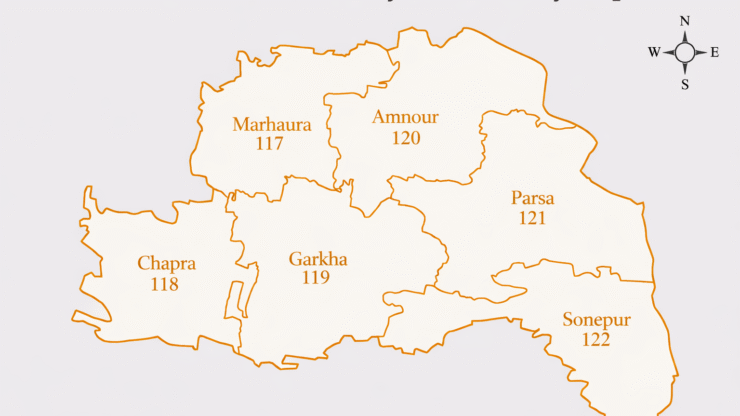
Constituency type: Lok Sabha-20. Saran Vidhansabha Includes Six Vidhansabha name 117-Marhaura,118-Chapra, 119-Garkha(SC Seats), 120-Amnour, 121-Parsa, 122-Sonepur .
State: Bihar
Saran Nature: Predominantly rural with semi, urban pockets
Political relevance: High (high turnout and intense competition historically)The impact of migration, agriculture and credibility of local leadership mainly determine voting pattern in this seat.
Demographic Profile of Saran
Sarans population is socially mixed and elections here are hardly ever decided by just one factor. Rather, the results are, to a large extent, an interplay of caste identity, community interests, and the perception of the candidate.
Saran Lok Sabha Election Results (2009-2024)
Saran Lok Sabha constituency has a vibrant electoral history, and the 2024 general election has become another close and competitive chapter in it. Here is a brief summary of last three general elections along with the latest results: https://www.aajtak.in/elections/lok-sabha-election-2024/bihar/saran-constituency-result-4520?
| Year | Winner (MP) | Party | Main Opponent | Opposition Party | Votes (Winner) | Votes (Opponent) | Victory Margin |
| 2009 | Lalu Prasad Yadav | RJD | Rajiv Pratap Rudy | BJP | 2,74,209 | 2,22,394 | 51,815 |
| 2014 | Rajiv Pratap Rudy | BJP | Rabri Devi | RJD | 355,120 | 314,172 | ~40,948 |
| 2019 | Rajiv Pratap Rudy | BJP | Chandrika Rai | RJD | 499,342 | 360,913 | ~138,429 |
| 2024 | Rajiv Pratap Rudy | BJP | Rohini Acharya | RJD | 471,752 | 458,091 | 13,661 |
*Volumes for 2009 are from general election reporting (broadest available figures; precise ECI data varies) same as traditionally cited.*
What Happened in the 2024 Election (Most Recent)
In the 2024 Lok Sabha election, Saran constituency was a tough fight between:
• Rajiv Pratap Rudy (incumbent, BJP) .
•Rohini Acharya (RJD), daughter of veteran leader Lalu Prasad Yadav .
Counting after 4 June 2024 confirmed that Rudy narrowly escaped defeat and retained his seat by a margin of 13, 661 votes, getting 471, 752 votes against Rohini Acharya 458, 091 votes.
The result was one of the closest margins in Bihar, indicating both intense campaigning by the parties as well as changing voter preferences.
Highlights:
•Rudy got a hat, trick of wins (2014, 2019, 2024) in Saran.
•Rohini Acharyas nomination brought in significant emotional and narrative elements, as she was contesting for the seat of her familys political legacy
•The narrow difference between votes indicates a close contest, where social configurations and local issues played significant roles in .
Electoral Trends: Saran Through the Years
2009
Lalu Prasad Yadav (RJD) was the winner of this seat, a well, known leader whose dominance in that part of the country was very marked. These times were about the impact of a big name and the support of a coalition. https://www.aajtak.in/elections/lok-sabha-election-2024/bihar/saran-constituency-result-4520
2014
Thanks to the Bharatiya Janata Party (BJP) wave under the National Democratic Alliance, Rajiv Pratap Rudy was able to defeat Rabri Devi (RJD) by a landslide.https://www.aajtak.in/elections/lok-sabha-election-2024/bihar/saran-constituency-result-4520
2019
Rudy not only retained his seat but also increased his margin of victory over Chandrika Rai (RJD), thus indicating the party’s organization and the support of various communities.https://www.indiatvnews.com/elections/lok-sabha-elections-2024/bihar/saran-constituency-result?
2024
Since this time the battle was close, one of the reasons for this could be that even if there are national level positive trends, the first loyalties and the strong mobilisation of the opposition still have an effect on the outcomes.
Profile: Current MP (2024 )
Rajiv Pratap Rudy, Bharatiya Janata Party (BJP), 2024 (third consecutive win), by 13, 661 votes over RJD’s Rohini Acharya, 471, 752 votes
Rudy’s domination in the last elections bears testimony to his substantial political acumen, the strong presence of his party on the ground, and his ability to draw support from various quarters within the constituency.https://en.wikipedia.org/wiki/Rajiv_Pratap_Rudy?
Electoral History and Political Pattern
Saran constituency has seen changes in the ruling party instead of being dominated by one party continuously. The constituency has been sending prominent leaders as MPs, and the political situation here has often been in line with the political trends in the entire state.
Sometimes, the result comes down to which party/parties are allied. Margins are influenced by the degree of support among the OBCs and minorities. Besides party branding, a person’s character and credibility at the local level matter the most.
Why 2024 Was a Big Year for Saran?
High, profile contest: Rohini Acharya’s involvement gave the poll a storyline of legacy vs incumbency.https://navbharattimes.indiatimes.com/state/bihar/saran/bihar-saran-lok-sabha-election-result-2024-rohini-acharya-rajiv-pratap-rudy-chunav-parinam/articleshow/110440857.cms?
Narrow margin: Rudy’s huge victory margin in 2019 was not there in 2024 which only produced a close fight. This is a sign of changing voter behavior.Alliance testing ground: The near, even score shows how coalition strategies and local narratives matter, not only national waves.
Depth, Wise Caste Composition (Estimated)
The following caste composition is an attempt at an analytical breakdown based on SC/ST Census data, academic studies, electoral rolls, survey patterns, and long, term political reporting. Percentages may differ from one assembly segment or booth to another.
Upper Castes (Approx. 15–17%)
| Caste | Estimated Share |
| Rajput | 6–7% |
| Bhumihar | 4–5% |
| Brahmin | 3–4% |
| Kayastha | 1–2% |
Political role:
Despite their smaller numerical strength, upper castes in Saran show high turnout and organisational coherence, giving them influence beyond their population size.
Other Backward Classes – OBC (Approx. 38–42%)
| Caste | Estimated Share |
| Yadav | 13–15% |
| Koeri (Kushwaha) | 6–7% |
| Kurmi | 4–5% |
| Teli | 3–4% |
| Mallah / Nishad | 4–5% |
| Nai & others | 4–6% |
Political role:
OBC voting in Saran is fragmented but decisive. Yadav voters often act as a core bloc, while non-Yadav OBCs respond more to candidate credibility and alliance composition.
Extremely Backward Classes – EBC (Approx. 16–18%)
| Caste | Estimated Share |
| Nonia | 2–3% |
| Dhanuk | 2–3% |
| Kewat | 2–3% |
| Kumhar | 2–3% |
| Bind | 1–2% |
| Other EBCs | 6–7% |
Political role:
EBC voters are often swing-oriented and highly sensitive to welfare delivery, local outreach, and booth-level mobilisation.
Scheduled Castes – SC (Approx. 17–19%)
| Caste | Estimated Share |
| Chamar / Ravidas | 6–7% |
| Dusadh / Paswan | 5–6% |
| Musahar | 2–3% |
| Dhobi & others | 3–4% |
Political role:
SC voting patterns depend on leadership representation, alliance signals, and welfare credibility, rather than uniform caste consolidation.
Religious Minorities (Cross-Caste Group)
| Community | Estimated Share |
| Muslims | 15–18% |
Political role:
Muslim voters in Saran often vote strategically, prioritising candidates perceived as electorally viable and locally responsive.
Basically:
There is a pretty even distribution of upper castes, OBCs, EBCs, Scheduled Castes, and minorities in the constituency.None of the groups enjoys an absolute majority.The election results are basically a function of coalition work.This variety makes Saran a semi, competitive constituency where alliances and narrative timing are very important.
Voter Behaviour and Political Psychology
Saran voters exhibit a seasoned political attitude. Although caste identity is a major factor, it is not the only one.
Good understanding of the problems at the local level Candidate’s availability for the voters matters Leadership, which is either well, known or has experience, is preferred Fair consideration for both national and local level issues This is why Saran is not a safe seat, nor is it one that changes just with the wave.
Key Local Issues in Saran
Politically engaged as it is, Saran still has development issues that remain unaddressed for a long time.
Among the problems most frequently mentioned are:
Work and migration , farm sustainability and water , for irrigation flood control for the low, lying areas the state of education and health care better road communication and repair of existing facilities.Those candidates who are able to link these issues with capable and credible solution gain more popularity.
Nature of Electoral Contest
Saran is not a territory for one, sided domination, rather it witnesses the following:
Mainly bipolars or triangular contest the strong presence of social coalitions the last moment voter decision Here elections are generally not decided by loud slogans but by ground, level coordination and voter trust.
Conclusion: Why Saran Matters?
Politically The Saran Lok Sabha constituency is a microcosm of the complex political reality of Bihar, where caste, community, leadership, and local issues intersect. The Saran electoral constituency is a melting pot of diverse communities, making it a perfect place for testing alliances and political strategies. The results here often serve as a guide for broader regional trends.
It is crucial to understand Saran if one wants to comprehend the electoral behaviour of northern Bihar.
Updated FAQ Additions
Who won the Saran Lok Sabha seat in the 2024 election?
Rajiv Pratap Rudy (BJP) emerged victorious in the Saran seat in the 2024 Lok Sabha election. He defeated Rohini Acharya (RJD) with a very close margin of 13, 661 votes.
What was the vote count and margin in the 2024 Saran result?
Rajiv Pratap Rudy got 471, 752 votes and Rohini Acharya got 458, 091 votes, the difference being 13, 661 votes.