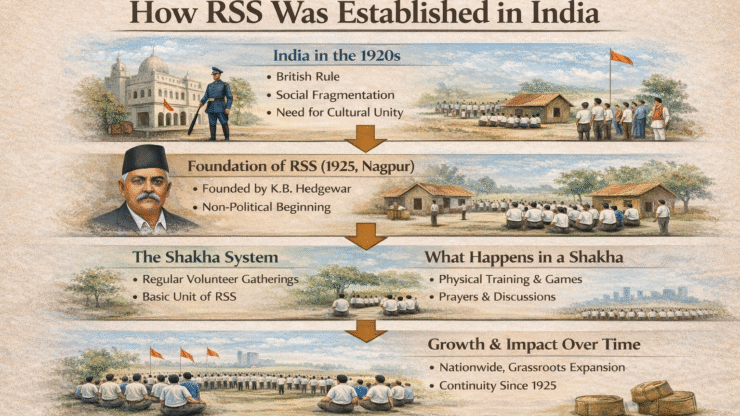
History and Early Years of RSS: How RSS Was Established in India
The Rashtriya Swayamsevak Sangh (RSS) is regarded as the most prominent socio-cultural organisation in the history of modern India. To comprehend the implications and impact of the RSS in the present scenario, it becomes pertinent to discuss the establishment of the RSS in the context of India and the model it used during its early years.
This paper discusses the origin, background, ideology, and early workings of the RSS with special emphasis on shakhas because these constitute the vital core of the organization.
Background Information on India during the 1920s
The RSS was born in a phase of extensive change and turmoil. India in the 1920s was characterized by:
1. British colonial rule
2. Rising nationalist movements
3. Social disunity based on caste, regions, or communities
4. Issues of cultural identity and social cohesion
It was felt by many leaders of the age that political freedom alone would not suffice without some form of social organisation and solidarity at the grass roots.
Who Founded RSS and When?
The RSS was founded in 1925 in Nagpur by Keshav Baliram Hedgewar, who was a physician and nationalist ideologue.
The long-term vitality and survival of India were to Hedgewar contingent upon the
1. Organised and disciplined society
2. Developing characters in citizens
3. Cultural oneness beyond regional affiliations
Rather than setting up a political party, he decided to establish a social organisation that is volunteer-based and centered on community involvement.
Historical Overview of How RSS was Established in India
The establishment of RSS was gradual and decentralised, rather than a large public launch.
In its early phase:
RSS started off with small meetings at the local level
There was no formal membership drive.
The involvement was voluntary and regular
The agenda centered on training people, not mobilizing mass support
This enabled RSS to grow incrementally across different regions.
The Shakha System: Core Activity of RSS
RSS’s founding as well as development is marked at its center by the shakha system, which to date is the prime activity of the organisation.
A Shakha is a regular body of voluntary members, generally held daily or on a weekly basis, in open areas like parks, school grounds, etc. Shakhas were literally the foundation unit of the RSS, from Day One, that is, 1925.
What Happens in a Shakha?
A typical RSS shakha includes:
- Physical exercises and drills to build discipline
- Games that encourage teamwork and coordination
- Collective prayer or recitation
- Group discussions on social, cultural, and national issues
These activities are aimed at character building, discipline, and social cohesion, rather than political campaigning.
Why Shakhas Were Central to RSS Growth
The shakha model played a crucial role in the spread of RSS because:
- It required minimal infrastructure
- It could be easily replicated in villages and towns
- It emphasised face-to-face community bonding
- It created a cadre-based organisation, not a crowd-based movement
Because of this decentralised and disciplined structure, RSS expanded steadily across India without relying on elections, mass publicity, or centralised authority.
Early Ideology and Objectives of RSS
The early ideology of RSS focused on cultural nationalism and social organisation, rather than electoral politics.
Its primary objectives included:
- Building strong moral character among individuals
- Promoting discipline and unity in society
- Strengthening cultural identity
- Long-term nation-building through social work
RSS leadership consistently emphasised that lasting national strength must come from society itself, not only from political power.
RSS in Its Early Years (1925–1947)
Between its founding and India’s independence, RSS expanded its presence across many parts of the country.
During this period:
- Shakhas spread beyond Nagpur to other regions
- A structured internal hierarchy developed
- Youth participation increased steadily
- The organisation remained focused on training and discipline
RSS did not participate directly in electoral politics during this phase, maintaining its identity as a cultural and social organisation.
Difference Between RSS and Political Parties
RSS is often confused with political parties, but there are clear differences.
| RSS | Political Parties |
|---|---|
| Cultural & social organisation | Electoral organisations |
| Shakha-based training | Vote-based mobilisation |
| Cadre development | Campaign-based structure |
| Long-term social focus | Short-term electoral goals |
While individuals associated with RSS have later participated in political life, RSS itself does not contest elections.
Why RSS Became Influential Over Time
Several factors contributed to the long-term influence of RSS:
- Strong grassroots shakha network
- Consistent training and discipline
- Decentralised organisational model
- Focus on continuity rather than visibility
These elements allowed RSS to survive political changes, social shifts, and periods of restriction while maintaining organisational stability.
Conclusion
RSS has been formed in India in 1925 as a cultural and social body, which has been working on a long-term nation-building process. However, its expansion was led not by electoral politics but by its shakha system, which has become its backbone till date.
To fully comprehend the importance of the RSS in Indian society, one must understand the historical background of the RSS, particularly the significance of shakhas.
FAQs: How RSS Was Established in India
❓ When was RSS founded?
RSS was founded in 1925 in Nagpur.https://www.rss.org/
❓ Who founded RSS?
RSS was founded by Keshav Baliram Hedgewar. https://www.rss.org/
❓ What is the core activity of RSS?
The shakha system, which involves regular local gatherings for training, discipline, and discussion, is the core activity of RSS.
❓ Why was RSS established?
RSS was established to promote social unity, discipline, and cultural organisation during a period of social fragmentation under British rule. https://www.rss.org/
❓ Is RSS a political party?
No. RSS is a cultural and social organisation, not an electoral political party.
❓ What happens in an RSS shakha?
Shakhas include physical exercises, group activities, collective recitation, and discussions on social and cultural topics.