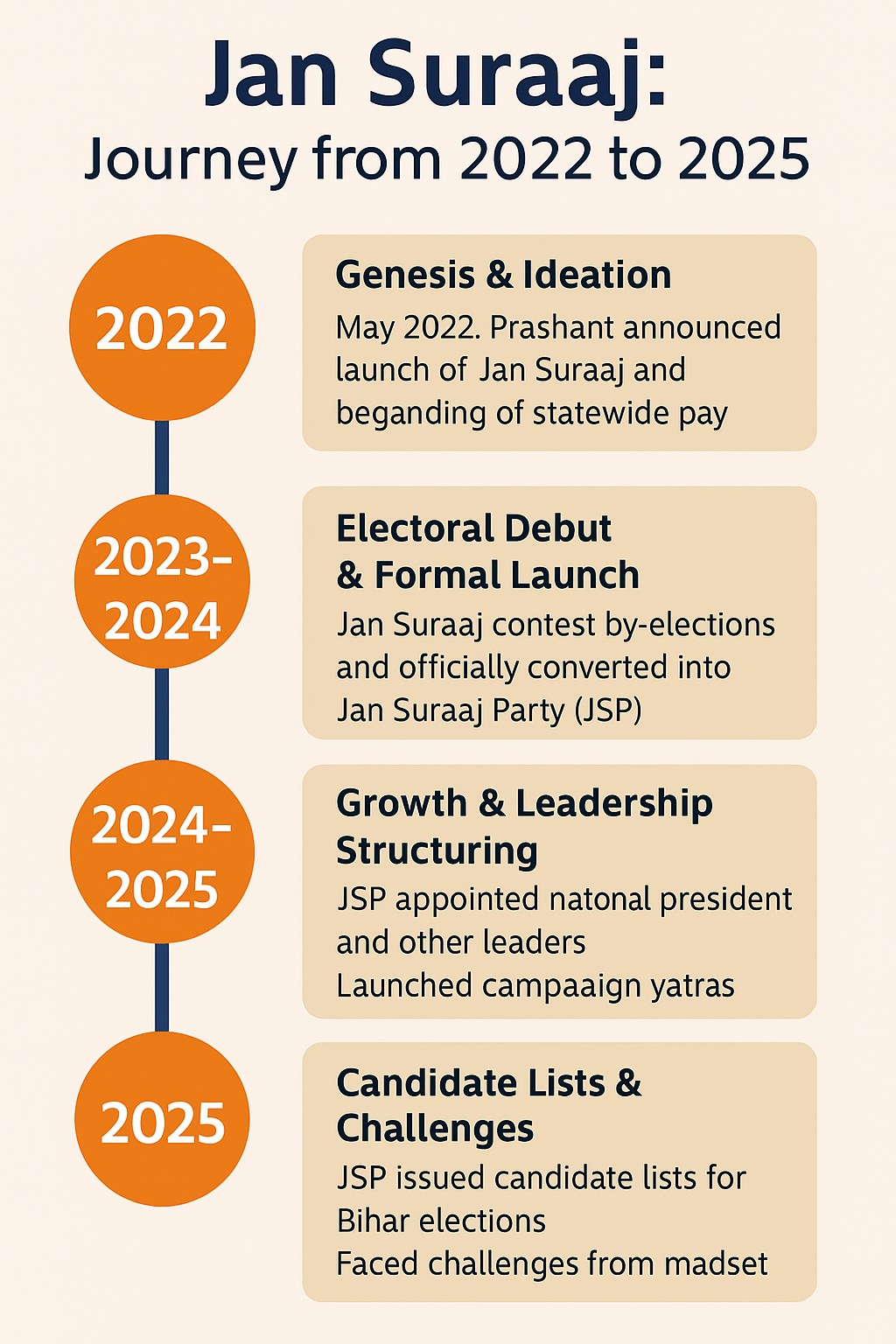
On 2 May 2022, Prashant Kishor first publicly hinted at launching a political initiative by tweeting: “It’s time to go to the Real Masters, The People”, introducing the idea of Jan Suraaj – People’s Good Governance. Wikipedia+1
This was shortly after he announced his retirement from being a political strategist, signaling a shift from behind-the-scenes strategy to active political engagement. Wikipedia+1
2. Padyatra / Grassroots Phase (2022–2023)
After the announcement, Kishor launched a statewide “padyatra” (foot march) across Bihar, visiting villages, towns, and local communities to understand real issues and gather ground-level insight. Wikipedia+2Wikipedia+2
This was done under the umbrella of the Jan Suraaj Abhiyan, not yet a formal party. Wikipedia+1
Over these months, the movement sought to build networks, identify local issues, test messages, and prepare a roadmap for governance reforms. Wikipedia+1
3. Electoral Debut & First Tests (2023–2024)
The movement transitioned from pure activism to electoral experimentation. In April 2023, Jan Suraaj-backed candidate Afaq Ahmad won a Bihar Legislative Council bypoll (in Saran, Teachers Constituency). This came as one of the first electoral successes. Wikipedia
In November 2024, Jan Suraaj contested by-elections in four assembly constituencies (Belaganj, Imamganj, Ramgarh, Tarari). The vote shares varied; some showed modest promise, though none translated into big wins. Wikipedia+1
4. Formal Party Launch & Structuring (October 2024)
On 2 October 2024 (Gandhi Jayanti), Kishor officially converted Jan Suraaj from a movement/abhiyan into a political party, named Jan Suraaj Party (JSP). Wikipedia+2Wikipedia+2
The party adopted symbols and structural features (e.g., logo, membership, internal democracy). Wikipedia
Kishor also laid out ambitious promises — to contest all 243 assembly seats in Bihar, adopt mechanisms like primaries, recall rights, and ensure many first-time contestants. Wikipedia
In October 2024, Manoj Bharti (a retired diplomat and IIT alumnus) was appointed as Bihar State President of the party. Wikipedia+1
In May 2025, the national-level leadership got more formalized: Uday Singh was made the First National President (in a 150-member state core committee) for JSP. Wikipedia
The party’s headquarters, ideology statements (Gandhism, social liberalism), and electoral positioning (centre to centre-left) were clarified. Wikipedia
6. Campaigns, Yatras & Public Outreach (2025)
In 2025, Jan Suraaj launched the “Bihar Badlaw Yatra” (Change Bihar March), aiming to cover all 243 assembly constituencies over ~120 days. The Times of India+1
Kishor also attempted symbolic gestures: e.g., starting from JP’s birthplace, making comparisons to Janata movement legacies. The Times of India+1
At the same time, the party began issuing candidate lists for the 2025 Bihar elections. The first list (51 candidates) was released in October 2025. Wikipedia+2Wikipedia+2
While there was speculation that Kishor might contest from Raghopur or Kargahar, he later announced he would not contest the 2025 elections, choosing to focus on strengthening the party instead. www.ndtv.com+2Wikipedia+2
7. Challenges, Criticism & Political Context (2025)
Jan Suraaj has had to confront the reality of Bihar’s entrenched party politics, resource limitations, and competition from established alliances.
There have been legal and political challenges: allegations of model code violations, pushback from existing parties etc. The Times of India
Kishor and JSP have made bold claims about seat targets, with rhetoric suggesting success or failure on their own terms. Navbharat Times
Further, the party’s expansion continues, with some former politicians and their lineages joining JSP, indicating growing acceptance. Navbharat Times
Reflections & What to Watch Ahead
Momentum vs Electoral Reality: Jan Suraaj has built significant buzz and ground presence. But converting that into seats in 2025 will be its biggest test.
Organizational Depth: The party’s ability to manage elections across 243 seats, enforce internal discipline, and deliver on promises will define its credibility.
Candidate Strategy: Their emphasis on first-time candidates, recall rights, and internal democracy will be under scrutiny.
Public Perception & Delivery: Citizens will judge them not only by promises, but by the clarity, feasibility, and transparency of their plans (e.g. Parivar Labh Card).
Alliances & Political Positioning: How Jan Suraaj positions itself vis-à-vis NDA, Mahagathbandhan, and other regional parties will matter.